Wednesday, November 11, 2015

Annotated Contact List

Annotated Contact List

My first topic is about the relationship between online interaction and whether it is changing our ability to interact with real human beings in the real world. In other words, whether we are humanizing or dehumanizing each other through online interaction. My second topic is about whether our ability to change and filter our selfies is making us dehumanize ourselves.

Homies:

  1. Mom: Sometimes I think she gets tired of me telling her about random school topics but she listens anyway. I want to ask her how she feels communicating via online/even text has changed since she was in high school. Has it made it easier for her to talk to people or harder for her physically? Has there been any instances where what she was trying to say didn't transfer through text? My mom takes selfies and has found new ways to filter and take better selfies. Do you feel like your selfies are a true representation of who you are? What do you think selfies say about other people?
  2. Boyfriend: He'll listen to anything I say. Has it gotten easier for you to interact with others and for others to interact with you? What do you think of girls/boys that post selfies or filter their pictures? He's not one to take selfies, so I would want to ask him what he thinks when he does take a selfie and what he thinks when other people take selfies. I would want to ask him if people's selfies seem to reflect something different than who they really are. This would be a casual conversation on the phone and he would give me his honest opinion. 
  3. Good friend, Sia: We always talk about online and digital media issues. How do you think online interaction has affected our ability to communicate with each other? Even with your topic of living in the moment vs. living in your phone---how has that affected the way we communicate with each other? Valued our relationships overseas? Or devalued the relationship across the dinner table? 
  4. Good friend, Kei: She likes to take a lot of selfies and understands the struggle of finding the right filter. I would ask: why do you like filtering pictures? Do you think that maintains the real value of the picture? enhances it? or degrades it? She is a communications major so she might be able to tell me which professors here would know about online communications. 
  5. Cousin, Brit: She is very familiar with selfies and the selfie culture. What do you think your selfies say about you? What does this person's selfie say about them? 

Peers:

  1. Girl in Shakespeare class, Rachel: We are taking Shakespeare together and she is also an English major who would be familiar with Renaissance culture and literature. Is there anything in Literature you think reflect an emphasis on the importance of relationships and physical communication?
  2. Kurt: He's also writing about a topic involving the real vs. digital world topic. How much of the digital world effects our real world?
  3. Ahna: she's talking about public image and having the right to be public or private, but I would ask whether or not she feels that going private has an effect on how that person is portrayed. Do you think trying to have the perfect image forces us to use filters and feel the need to photoshop? 
Experts:

  1. Dr. Danette Paul: she is my Digital Culture professor and has a good understanding of current digital media and culture. I would probably want to ask her a similar question that I asked my mom, that is, how has your methods of communication changed over your life time? Does the way of communicating now make it easier to talk to others or more difficult? How? 
  2.  Dr. Richard Duerden: he is my Shakespeare professor and was also my Contemporary Theory professor. He would have a good understanding of how the Renaissance period focused on communication and the language sent to each other. I would also want to talk to him about how the Renaissance culture (even Shakespeare through his plays) understood the power of language and physical contact with the other. He would also have some good ideas about how the self-image is such an important part of Renaissance and court culture
Enthusiasts:

  1. Photographer, Tiffany: How do you filter/edit your photos? Is it to enhance the value of the picture? To enhance the value of the moment? To capture the essence of something? Do you ever feel like editing a picture degrades the picture? Is there something special about raw photos? 
  2. Mary Chapman: she's a librarian for popular culture at the HBLL. I already asked her about online interaction/dating but I didn't get a chance to ask her about the selfie culture and she might know more about that. 
  3. Quinn Galbraith: when I asked Mary Chapman for information she directed me to the Family Sciences research guide and Quinn Galbraith is the librarian for the Family Sciences. He would probably be able to help me find resources regarding the online interaction topic.
  4. Some professors that I might get into contact with from my friends who are communication majors. 

Wednesday, October 7, 2015

Thoughts on Primary Sources

I thought I would share some of the things I found while doing research - I'm in the Sprezzatura section, but I found a couple of fun things that maybe might help people in other groupings.

The Online British Library: they have a selection of original texts scanned into digital format, definitely worth poking through. For the Ad Fontes or Printing groups, there are a couple Bibles. For the humanists, there's part of the treatise put together by the first guy to study anatomy through human autopsy (apparently he was inspired by humanism, AND he's from the Renaissance). Go check it out.

John Lydgate: an author spanning the before and after of the printing press. The link takes you to a catalog of sorts of his publications; some of them are texts written just before the printing press, then republished with the new technology. Some of them are by other authors. We've talked a lot about the resurrection of old, old sources in the Renaissance, and we've talked about the press being a new medium allowing for wide dissemination - and I thought it interesting how Lydgate combined the two.

Our subject for the eBook is the digital age, as seen through the Renaissance - which means we're basically looking at the social changes resulting from new technologies. So I thought it might be interesting to try and see, very briefly, what the Renaissance was changing from. So if anyone finds sources about the late middle ages - or knows of some good ones - that'd be awesome. (Maybe even Renaissance authors who talked about it? Their perspective would be pretty cool to dig into.)

And if you run into any good primary sources for court culture, beyond The Prince or The Courtier, let me know? I'm finding tons and tons of articles (secondary sources), but not a lot of primaries. The wiki page dealt mostly with the idea of love - and I'd like to look at the actual politics and dynamics of the court, especially on an international scale. I'm really interested in how personal rhetoric and human interaction coincide.

See you guys in class!

Tuesday, October 6, 2015

Six Principles for Project-Based Learning

In my current Renaissance Literature course, we have turned a corner and begun a new phase. While we will continue reading Renaissance literature, we will do so for the express purpose of producing an ebook which we will publish by semester's end.

We've moved to a new classroom, a computer lab, signally formally a shift from lecture-and-discussion to management-and-production.

I want to orient my students for what is to come, because project-based learning is just not the same animal as traditional, classroom-based instruction. Here are six principles for succeeding at this project-based approach to learning:

  1. Keep the End in View
  2. Be Flexible
  3. Take Initiative
  4. Work Together
  5. Own It
  6. Find the Stakes and Stakeholders

Ad Fontes Chapter - Draft


The Fountain
Ad Fontes is Latin for ‘back to the sources’. It seems appropriate that we label this cultural phenomenon in Latin, because that’s what it was all about. It was a rediscovery of Latin by Francis Petrarch, the poet who wandered deep into the library. His rediscovery of Latin reopened the possibilities of language. Petrarch was essentially the guy I work with who knows excel really well. All he did was spend some time on youtube and wikihow, but now he can accomplish the work it takes me 45 minutes to do in 5 minutes. The is knowledge readily available to anyone with the motivation to find it, but once you do find it you have the edge over everyone attempting the same thing.  Petrarch saw the inefficiency in the use of language around him, or the sad use of excel around him, decided to go back to the how-to manual and changed everything.  For Petrarch, the manual was written by an ancient Roman philosopher and orator named Cicero. This re-discovery of language gave Petrarch the edge. It essentially have him rhetorical magic.

The Scholar
The Tempest, by William Shakespeare, is a play lead by the character Prospero, a duke overthrown by his brother while he too was wandering deep into the library. Though he was betrayed and exiled to a mysterious island, he took his library with him. His books sourced him with magic that made him ruler of the island and lord to some strange creatures.

The Consequences
Prospero becomes an example of the elevated abilities of someone who has ‘returned to the sources’. His abilities are dramatically heightened as he holds supernatural control over the inhabitants of the island and the tempest itself. One of the island natives, Caliban, identifies the source of Prospero’s power. In act 3, scene 2, line 92, he plots to overthrow Prospero and highlights the importance of Prospero’s library.

First to possess his books, for without them
He’s but a sot, as I am, nor hath not
One spirit to command.

Caliban knows the extent of Prospero’s powers because Prospero taught Caliban how to speak. A duke to turn tutor is a massive change in social status. Social status in Prospero’s case is unusual as he was cast out of society and forced to make acquaintance with island natives. Though this does change the importance Prospero would place on his reputation, it is worth noting how far a descent it would be (Shin 375). The choice to become Caliban’s teacher shows how importance he afforded language and the weight he gave to education. Heightened thinking becomes an issue for Caliban when Prospero, after a dramatic betrayal, forces him to revert to the life of a slave. His powers are increased but his freedom to exercise them is decreased. In act 1, scene 2, line 364 he curses Prospero in frustration.

You taught me language, and my profit on’t
Is I know how to curse. The red plague rid you
For learning me your language.

The source of the characters progress, be it Caliban or Prospero, comes back to power of language and the study of the liberal arts. I can identify with Caliban’s experience of returning to the sources. The longer I am in collage more I strain at the confines of academic life and the greater desire I have to enter the ‘real world’ and effect change. My education helps me see my potential and gives me the tools to realize it. Prospero’s experience with Ad Fontes is less relatable, but infinitely more exciting. Maybe if I spent more time in the Library…

Works Cited
Shin, Hiewon. "Single Parenting, Homeschooling: Prospero, Caliban, Miranda." Studies In Literature, 1500-1900 48.2 (2008): 373-93. Rice University. Web.

Shakespeare, William. The Tempest.

Sprezzatura Chapter Draft

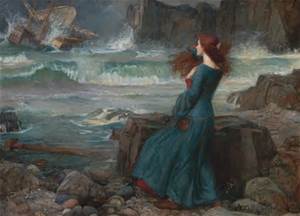
by John Everett Millais, 1852


Sprezzatura

“One change,” wrote Machiavelli, “always leaves a dovetail into which another will fit” (2). And change is exactly what the Renaissance was: change in language, change in religion, change in politics. Governments became highly competitive, both between nations and within the murky confines of individual courts, and melded with new societal values tied to literature and the measure of man (Knecht). The result was a battleground of posturing and preening as nobles vied for social supremacy, and from this murk arose the word sprezzatura, or excellence without apparent effort.

This was the ideal of the courtier, the standard imposed upon him: that he must excel in all arts, all sport, all methods of leadership, all morality, all the things that might possibly reflect on his character. He was the epitome of the good in humanity – and he rose to the position without effort, because he was simply that good.

Now, we all know this to be bologna. Or we believe it to be bologna; our current society is painfully aware of the duality of human nature. We see it, we live it, we are it: we post it online, share it, blog it, unabashedly vomiting the cruelty of humanity onto public spaces where names go unknown and faces unseen.

The Tempest

Written in 1610, toward the end of the Renaissance, The Tempest was Shakespeare’s exploration of the Court and human duality. An eclectic group of nobles find themselves stranded and separated on a strange island of strange magics; and here, ripped from the familiar comforts and wealth of their native courts, they begin to reveal their true selves, the true man muffled and smothered by the inherent artificialities of government.

Alonso, King and top of the food chain is, perhaps, the only character in the play who doesn’t think of his political power or position. His only thoughts throughout the play are for his lost son. Indeed, Alonso is a peculiar noble. Single minded, somewhat oblivious, he seems to function mostly as an object of pitiful desire: desire, because the other characters aspire to his power; pitiful, because the most powerful man, politically, is reduced to a shuffling, shambling mess of melancholy, grief, and guilt.

His son – very much alive, and very much in love – also retains his goodness, and perhaps embodies the sprezzatura man. He is athletic (2.1 114-123), physically attractive (1.2 417-419), and in the face of enforced servitude, declared, “The very instant that I saw you did / My heart fly to your service, there resides / To make me slave to it” (3.1 64-67). Key to his character is his retention of these qualities, even after his fall from prince to slave. The happiest man throughout the play, Ferdinand is the poster boy for everything the nobleman strove to be.

Their associates are not. Sebastian, brother to the King, and Antonio, plot regicide. When asked after his conscience, Antonio scoffs, “Ay, sir, where lies that? …I feel not / This deity in my bosom” (2.1 277-279). Quick to lie, quick to scheme and plot for their own advancement, Sebastian and Antonio are closer to modern expectations of politicians. Though painted in a veneer of courtly goodness, their insides rot.

Today

There exists another island, another strange land were men lose themselves, are stripped of public personas and reveal the face behind the mask. But our island has a name.

It’s the internet. Specifically, it is the public forum, where names and faces change owners in an eye blink, where even mothers might be prevented from recognizing their own sons. Hidden behind anonymity, we become fearless. Where is the consequence? Who can catch us, who will know?

Ours is a world of King Alonso`s, lost Ferdinand`s and rotting Antonio`s.

This section needs more work. And perhaps a better argument. Hrm.


Works Cited

Machiavelli, Niccoló. The Prince. Trans. N. H. Thomson. Ed. Philip Smith. Dover Publications, Inc.: New York (1992). Print.

Shakespeare, William. The Tempest. Ed. Virginia Mason Vaughan, Alden T. Vaughan. Bloomsbury Arden
Shakespeare: London (2014). Print.

Knecht, Robert J. “The French Renaissance Court.” History Today 57.7 (July 2007): n.pag. History Today. Web. 4 October 2015.


Monday, October 5, 2015

Court Culture draft

Court Swag
“Swag” is what we would call our present day “Sprezzatura” or Renaissance Court Culture. The Court, in general, was the political head and symbol of power in the British Renaissance. Because of this power, members of the court had to be experts in everything, they ultimately had  to have “swag” wherever they went. In our class discussion, we talked about what it means to have the courtly “swag.” In the Courtier, we learn that members of the court must be well learned, well read, must speak a foreign language and be athletic. In other words, “courtiers were expected to be richly dressed and to be generous patrons […] talented all-rounder, skillful in courtly conversations, spoits, dancing and the arts - with an air of easy grace of recklessness.” 
Besides the actual qualities of a courtier, the court itself referred to the entourage of the Queen and the actual presence of the Queen during the Renaissance period. It “[court] was wherever the Queen happened to be and was made up of all those who surrounded the Queen from servants to the courtiers themselves.” This suggests that not only was the court a physical way you had to act and be trained, but it was also wherever the court physically appeared. This also suggests that the court demanded a sort of behavior around them and it was expected of them to behave in a certain way.


Court Culture in The Tempest and the Complex Nature of Miranda
In The Tempest, Prospero is introduced as an ex-Duke of Milan. He says, “Twelve year since, Miranda, twelve year since, / Thy father was the Duke of Milan and / A prince of power” (Act 1?). This immediately establishes a sense of court culture even though Prospero and his daughter, Miranda are not physically in a court-like atmosphere. His mere authority in being an ex-Duke supports the idea that the court was more about where the nobles and royals were rather than the physical structure of a place reflecting a place of high courtier and courtship. Another aspect I would like to bring into this discussion of court culture in The Tempest is the complexity of Miranda as a woman of the court. At this time, there was a lot of skepticism about Queen Elizabeth and her ability and capabilities as a woman in a male-dominated society to rule. This was reflected in many of Shakespeare’s plays, including The Tempest through Miranda. Although Prospero threatens to have fatherly and courtly rule over her, Miranda ultimately leaves her father and goes on to love who she wants rather than who her father would like her to marry. This suggests that she rebels against Court culture and the idea that men held all power. 
However, this idea is challenged when she completely submits to her husband. In Act III she says, 

But this is trifling, / And all the more it seeks to hide itself / The bigger bulk it shows. Hence, bashful cunning, / And prompt me, plain and holy innocence. / I am your wife, if you will marry me. / If not, I’ll die your maid.”

This suggests a complete subjection to male authority and an opposition in the previous idea of her rebellion against her father. In court culture there was a constant struggle and complexity between female and male authority in Court culture and how women should behave in the court.  


[I’m having difficulty ending here or trying to find an ending. I also think I am going to far into the authority thing…]

Duality in Humanism- Draft

Prospero: The Original Jekyll & Hyde


For years The Tempest was seen as the closing masterpiece of Shakespeare’s career as a playwright Many scholars initially read it as Shakespeare’s swan song, but over time an awareness of the effects of colonialism was born and as a result people began to read this text through what is called “postcolonial lenses.” The relationship Prospero has with characters such as Caliban, Ariel, or even Miranda came under fire as scholars saw him as an executor of slavery and patriarchy.
The Conflict of The Scholar
When scholar Robert B. Pierce originally critiqued The Tempest he expressed a sympathetic view toward Miranda and Prospero. Yet the rise of the postcolonial interpretation forced him to re-evaluate his original sympathetic reading. Instead of taking sides or discrediting the new lens completely, Pierce decided to accept that there was merit to the new interpretations of Prospero. Pierce’s conflicted understanding of The Tempest lead him to conclude that maybe we needed to redefine the way we understood  the meaning of the play. In a rather bold academic move, Pierce accepts both as valuable and necessary to his understanding of the play. Prospero and Miranda’s exile is worthy of sympathy, but at the same time the colonialist relationships that permeate the work give rises to a less than friendly view of Prospero.
While it can be argued that Prospero is justified in demonizing and belittling Caliban for his attempted rape of Miranda, it is nevertheless curious that Prospero keeps Caliban around as a servant rather than banishing him from the island—or even killing him since Prospero probably has the power to do so. For Prospero there is a profit in keeping Caliban around. When we first meet Caliban, Miranda expresses her deep dislike to her father by saying, "’Tis a villain, sir, I do not love to look on." Miranda has reason to loathe Caliban; throughout the play we know that Miranda's ultimate characteristic is her virtue, her untainted purity, and Caliban nearly robbed her of this. Prospero replies to Miranda's complaints by saying, "But as ’tis,/We cannot miss him; he does make our fire, /Fetch in our wood, and serves in offices/That profit us" (1.2:310-314 emphasis added). So while, Prospero may have reason for mistreating Caliban, he finds a way to benefit from it, but this does not change the fact that Prospero is still a victim of an usurpation plot that left him dethroned and outcast from society.
The Reconciliation of Victim vs Perpetrator
These two intertwined ideas of victim and conqueror may seem difficult to reconcile, but we don’t have to. Prospero can be both a victim and a perpetrator of the evil that exists in his world. A modern application of this can be seen with pedophiles and domestic violence perpetrators. It is often the case that those who were abused as children or witnessed abuse in their home, grow up to inflict the same type of violence upon others. The fact that perpetrators in scenarios like these were once victims too does not change, despite their own partaking of such abusive acts. In fact, knowing the history of an abuser can lead to a better understanding of the development of such a character. Similarly, as we look at the rejection Prospero experiences we may gain some insight into the type of servitude he thrusts upon Caliban, making it so that The Tempest ceases to be a text solely about a betrayed ruler or solely about a self-interested conqueror, but rather both. If Prospero is both a victim and a perpetuator then we are forced to ask ourselves how or if other characters, like Caliban and Miranda, may likewise be the embodiments of seemingly opposite characteristics.


Works Cited:


Pierce, Robert B. "Understanding "The Tempest"" New Literary History 30.2, Cultural Inquiries
(1999): 373-88. JSTOR. Web. 27 Sept., 2015.


"Statistics on Perpetrators of Child Sexual Abuse." Reporting on Child Sexual Abuse. The
National Center for Victims of Crime, n.d. Web. 05 Oct. 2015.  
<https://www.victimsofcrime.org/media/reporting-on-child-sexual-abuse/statistics-on- perpetrators-of-csa>.