Petrarch's love letter to Homer is familiar and expresses the admiration and adoration we all feel at some point. Who among us has not fawned over the genius of someone long dead? He writes in flattery and humility, calling Homer 'Master', and praying that his imitations might be of worth. Petrarch talks of being remembered and how the people are forgetting the masters of old, caught up in fame and fortune.
Petrarch's second letter is a bit more mild in admiration, his compliments seems a bit less worshipful at least. In both letters he writes as though the dead can answer, telling them what became of their works and legacy. There is again the lament of their name being known, but their works little read as money overtakes the mind of men. Petrarch writes with the familiarity of a friend, as though they would be kin in another life which is exactly what Petrarch hopes for.
The world Petrarch describes is one where books that are a little challenging are cast aside for simpler texts, a concept which might be unfortunately familiar. Men have given up the 'sweetest fruits of knowledge' in exchange for lazy luxury and wealth.
Showing posts with label Petrarch. Show all posts
Showing posts with label Petrarch. Show all posts
Wednesday, September 2, 2015

Petrarch and His Pen Pals
The
subject of each of Petrarch letters seems to be his admiration for each ancient
poet and philosopher, giving insight to the feelings behind Ad Fontes. He
worshiped these men and their genius in contrast to his own environment of
intellectual darkness. He denounces his academic peers, yet keeps himself
somehow separate.
"Your fame extends far and wide; your name is mighty, and
fills the ears of men; and yet those who really know you are very few, be it
because the times are unfavourable, or because men's minds are slow and dull,
or, as I am the more inclined to believe, because the love of money forces our thoughts in other directions."
What interested me most is how the letters
themselves act as the source of Petrarch’s familiarity, authority, and divine
all to action. Within this quote, two groups of people are identified. There
are the slow minded masses, unable to truly know Homer, and the select few
capable of familiarity. It is implied that Petrarch includes himself among the
few. This is implied as he interprets Homer’s writing and claims understanding.
What really claims mutual understanding, however, is this whole bizarre
interaction. The collection of letters is titled The Familiar Letters! He counts himself apart of Homer’s club and
Cicero’s club and these personally worded letters are proof of his membership.
As an intelligent person in the 14th century, he must
have understood the realities behind writing to someone in the BCs. The letters
will more than likely be returned to the sender. The conversation was within
himself, yet I wonder how much of him really believed that. The letters
themselves convey the feelings of a fully invested mind, never acknowledging
the impossibility of the conversation. The correspondence seems to affect his
life in the same way a real correspondence would. This friendship with his idols grants him authority in
opinion. With people like Homer and Cicero in your corner, how could you not be
the one with in the right, enduring a generation of those in the wrong?
Petrarch’s
communication with the dead takes on a divine nature as he receives return
communication through their written work. Cicero calls to Petrarch from beyond
the grave in his hour of doubt to reveal his destiny. This destiny is to copy
his work. In these letters the scholarly merits of Ad Fontes become secondary
to the supernatural and familiar command to return to the sources.
Ad Fontes and Petrarch: H & P Forever
Well, I think that it is abundantly clear who Petrarch's favorite classical author is. Homer, the father of Western literature, is certainly an important figure to know about and to study. Personally I have read his Odyssey and his Iliad and I find that he is a very talented and proficient story teller. Though I am less familiar with the works of Cicero, the passion that Petrarch feels about his writings is unmistakable.
Petrarch laments that the people of his day and age are too caught up in the world, caught up in making money and gaining fleeting fame, to appreciate the masterpieces of the past. He also seems to indicate that it is through his own study of Homer and Cicero that he has been able to write things worthy of imitation, and so one can see the buddings of the idea of Ad Fontes in the Renaissance. Because his own creativity is fed by the creativity of classical authors, the implication is that any writer or poet or artist can be inspired if they would only return to the past, to the sources of their initial desires.
I believe that what we decide to make our life's work is largely determined by the works of others that we have experienced in our lives. We are inspired by the art that we see or the music we hear to become artists and musicians. Art (and by extension, literature) does not spring fully formed from a vacuum like Athena of old; rather, it is created by the previous generations, just as the Gods were influenced and shaped by the Titans in Greek mythology. Perhaps I could spark my own cultural Renaissance even more by copying and imitating the works of classical authors like Homer and more contemporary ones such as Shakespeare.
Petrarch's "Fan-girling" and desire for Ad Fontes
The theme of Ad Fontes is clear in all three of Petrarch’s letters. I felt like I was reading fan letters to highly revered authors; I felt like Petrarch was “fan-girling.” In his first letter, “To Homer,” the way he praises and adores him is a clear fact that he praises and adores the sources. A quote from the last section highlights this idea,
“For a long while I have been talking to you ask if you were present; but now the strong illusion fades away, and I realize how far you are from me. There comes over me a fear that you will scarcely care, down in the shades, to read the many things that I have written here. Yet I remember that you wrote freely to me.”
These few sentences sum up how Petrarch feels about Homer: his work is impeccable and he wishes that it would have more influence in his own society.
In the second letter, the theme of Ad Fontes is clear through the harsh description his own society. He admits that, people in his own generation have minds that are “slow and dull” because they are focused on money instead of great ideas that are presented in the work of “the sources” (like that of Marcus Tulles Cicero’s). He also says that it is a “great grief” that his own generation does not look at “the sources,” indeed, a “waste and spoil.” This harshness toward his own generation emphasizes his love for and desire to go back to the sources.
Finally, in his third letter, Petrarch emphasizes the importance of copyists, which implies that he wants us to copy ideas from the past, as opposed to coming up with our own. The fact that Petrarch copies what he reads from these sources of the past, testifies to his admiration of the sources. You would only put forth effort to copy something if you truly loved something and wished to preserved it.
Petrarch And His Saucy Homage

"Your Penelope cannot have waited longer nor with more eager expectation for her Ulysses than I did for you." (Petrarch)
Doubtless if any of us readers would jump at the opportunity to become close-correspondents with our favorite writers, but only Petrarch would do so one-sidedly and yet still come across as admiring and teasing at the same time. Petrarch brought writers back to life by calling attention to their influence.
It takes an incredibly empathetic perspective to see the intent beyond the writing of long-dead, almost-legend authors such as Homer and Cicero, and yet he was capable of addressing the human creator beyond their works, knowing that obscurity would be their greatest fear. After all it is a fear that Petrarch himself relates to as seen in the concluding lines of his letter to Homer when he seems mournful despite how freely Homer has spoken to Petrarch, Homer will never receive or care to read Petrarch's observations.
The common theme throughout his letters is pointing out how much Petrarch's contemporaries owe to these early writers. He frequently mentions that although they may not be mentioned by name, it is impossible to overlook their obvious influence. He is constantly, although teasingly, soothing their egos by pointing out that time has not silenced their works.
But in his letter to Castiglionchio, regarding the importance of saving older works from obscurity, raises an issue central to the Ad Fontes spirit of the Renaissance, which is to say that true knowledge is timeless and unaffected by change. Revelations of the past are just as important and beautiful in the modern day.
He also, of course, takes a moment to taunt his author correspondents. Of course.
Tuesday, September 1, 2015
Petrarch Blog-A tradition of tradition

Petrarch’s use of a “letter” to
communicate with his fictional heroes is a clever method to both express his
admiration for and sincerest questions to his models. My understanding of the
theme Ad Fontes is simply its definition: Looking back to the sources. In
Petrarch’s letter to Homer he illustrates Ad Fontes brilliantly by
congratulating Homer on having so many imitators and that he himself (Petrarch)
also hopes to have succeeded in creating enough good literature to inspire his
own imitators. His hope also is that those same imitators will surpass him and
will continue a tradition of improving imitation.
In
Petrarch’s letters there is this theme of tradition or Ad Fontes is repeated.
Its importance was especially impressed upon me when reading the letter to
Cicero and seeing Petrarch lament the fact his generation had lost original
work by Cicero. This lack of original sources means to Petrarch that his
generation and all after him are unable to continue their striving effort at
improving upon what has been laid before. This point is further strengthened in
Petrarch’s letter concerning the scarcity of copyists. Petrarch was eager to
read the great works of Greek and Roman nationality but there were not
sufficient means to translate their works and share them. He then underwent the
work himself and worked tirelessly at it. He was inspired to learn in his
copying of Cicero's work that his hero Cicero also participated in the copyist
profession. Seeing Petrarch and Cicero both in their respective era’s giving
priority to Ad Fontes is truly remarkable and gives me a sense of
responsibility to give more priority to the great works of literature I have
available to me today.
Petrarch: Conversations with the Dead
It took me almost a full minute to realize Petrarch was
writing letters to dead men – which should have been more obvious, because I
started with his letter to Homer. Three letters later, I’m still unsure as to
why he would.
Is he trying to connect more intimately with the revered
authors of his education, as his era attempts to reestablish enlightenment by
returning to a previous one? Perhaps by addressing his essays to the men behind
the texts, he hoped to bring them from the past to his present. Maybe he wanted
to feel smart.
Or maybe he was experimenting with literary criticism, which
is our way of entering in a dialogue with something we’ve read. Today we like
to focus on the text itself, dissecting and categorizing it like literary
grave-diggers. Then, rather than throwing that analysis at a person, we use it
as a spyglass to peep on history. We dig graves to make time machines. Perhaps
Petrarch invented a time-machine to dig at the graves of ancient writers.
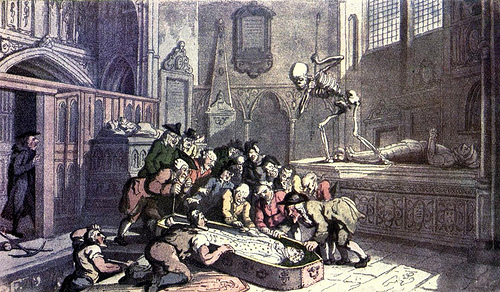 |
| Image Credit goes to Ephemeral Scraps on Flickr. License found here: https://creativecommons.org/licenses/by/2.0/legalcode |
OR: his time machine was not so he could communicate with the
deceased, but so the public could. I imagine he knew Homer would never read,
much less respond to, a letter written several centuries later. Death is a huge
communication barrier. I wonder if hiding behind the audience of “Homer” and “Tullius”
were the faces of his contemporaries, and he thought to introduce the living to
the dead.
Then he wrote to a living man and treated the texts as dear
friends. We still do that – sometimes going even a step further, and
befriending not the author, but the characters within. Which leads me to a
question you are free to ignore: do “literary” texts create a disconnect
between people the way social media does today? They both began as forms of
communication, but both also have elements of removing, replacing and altering
the speaker’s presence in the conversation. And then they traverse time and
distance so that a man some three-thousand years ago can say something to a
twenty-first century undergrad half a world away.
Subscribe to:
Posts (Atom)